AI in Accounting: How Artificial Intelligence is Redefining Finance Teams
Artificial intelligence (AI) is fundamentally reshaping modern finance. For CFOs, controllers, and accounting teams, AI is no longer a futuristic concept—it is an everyday operational driver that eliminates manual bottlenecks, strengthens audit accuracy, and turns raw financial data into real-time business strategy.
As competition tightens and skilled accounting talent becomes harder to retain, adopting AI-driven accounting tools has become essential for sustainable growth. At Introv, a leading IT consultancy and Oracle NetSuite Partner in APAC, we help finance leaders modernize their accounting operations with intelligent cloud solutions. Below, we break down the core technologies behind accounting AI, the tangible ROI for businesses, common adoption hurdles, and how an AI-powered ERP brings it all together.
What Is AI in Accounting?
AI in accounting refers to the application of advanced algorithms—such as machine learning, natural language processing, and generative AI—to automate repetitive financial workflows, analyze massive datasets, and forecast business outcomes.
Rather than relying on manual spreadsheet entry and retroactive reporting, AI-enabled accounting systems process structured and unstructured financial data continuously. This shift allows finance departments to move away from transactional bookkeeping and focus on high-value financial planning and analysis (FP&A).
Core Technologies Powering Accounting Automation
While “AI” is often used as an umbrella term, modern financial software relies on four distinct AI engines—often paired with two foundational automation tools:
| Technology | How It Works in Finance | Primary Accounting Use Cases |
| Machine Learning (ML) | Algorithms that learn from historical data patterns without explicit reprogramming. | Anomaly/fraud detection, automated general ledger (GL) coding, and SKU-level revenue forecasting. |
| Deep Learning | Multi-layered neural networks modeled after the human brain for complex pattern recognition. | High-accuracy credit risk scoring, complex cash flow modeling, and predictive audit risk assessment. |
| Natural Language Processing (NLP) | Interprets, extracts, and summarizes human language from text documents. | Reviewing vendor contracts, monitoring regulatory updates, and scanning customer feedback to estimate return reserves. |
| Generative AI | Creates new text, summaries, and financial narratives based on user prompts. | Drafting management reports, summarizing budget variances, and automating client/vendor communications. |
| RPA (Robotic Process Automation) | Rule-based automation (non-AI) that executes repetitive digital tasks across systems. | Three-way matching (POs, receipts, invoices), travel expense policy checks, and automated revenue posting. |
| OCR (Optical Character Recognition) | Digitization tool (non-AI, now enhanced by ML) that converts scanned images into searchable text. | Touchless accounts payable (AP) invoice capture and digital receipt archiving. |
6 Key Benefits of Integrating AI into Accounting Operations
- Accelerated Month-End Close & Efficiency: Automating routine reconciliations, journal entries, and invoice matching slashes close cycles from weeks to days.
- Higher Data Accuracy: Eliminating manual keystrokes drastically reduces human error, GL misclassifications, and costly rework.
- Proactive Fraud & Anomaly Detection: Instead of relying on traditional audit sampling, AI scans 100% of transactions in real time to flag duplicates, policy violations, or suspicious outliers before funds leave the business.
- Continuous Regulatory Compliance: AI systems cross-check transactions against accounting standards (such as GAAP or HKFRS/IFRS) and alert teams to regulatory shifts, reducing audit exposure.
- Scalability Without Headcount Bloat: With global accounting talent shortages driven by burnout, AI absorbs rising transaction volumes so lean finance teams can support rapid business expansion.
- Data-Driven Executive Decision Support: By unifying financial and operational metrics, AI delivers instant cash flow projections and scenario modeling to leadership.
Practical Use Cases: AI in Action Across the Finance Function
- Touchless Accounts Payable & Expense Management: AI extracts line-item data from vendor bills, matches them against purchase orders and delivery receipts, and routes only exceptions for human approval.
- Dynamic Cash Flow Forecasting: By analyzing historical receivables, payables, and seasonal trends, AI predicts liquidity gaps early—helping treasurers optimize working capital and avoid unnecessary borrowing.
- Full-Population Auditing: Internal and external auditors use AI to evaluate entire ledgers during the risk-assessment phase, uncovering hidden anomalies faster than manual spot-checking.
- Automated Variance & Benchmark Analysis: AI consolidates multi-entity data to highlight budget-vs.-actual discrepancies and generates plain-English explanations for department heads.
- Smart Receivables & Client Communication: AI prioritizes overdue accounts, drafts tailored payment reminders, and prevents embarrassing errors—like sending dunning notices to clients who have already paid.
Overcoming Common AI Adoption Challenges
Implementing AI requires more than buying a standalone tool. Finance leaders typically navigate four hurdles:
- Siloed & Legacy Systems: AI is only as reliable as the data feeding it. Disconnected spreadsheets and outdated on-premise software produce fragmented, inaccurate insights. Solution: Partner with an experienced IT consultancy to consolidate financial and operational data onto a single cloud ERP.
- Upfront Implementation Costs: Building custom AI tools is expensive. Solution: Leverage cloud ERP platforms with built-in AI features to gain immediate ROI without heavy R&D overhead.
- Data Privacy & Governance: Financial records are highly sensitive. Ensure your software adheres to strict enterprise security, role-based access controls, and regional data compliance standards.
- Team Upskilling: Transitioning staff from data entry to data analysis requires change management and targeted training led by executive sponsorship.
Why Clean Data and Cloud ERP Are the Foundation of Accounting AI
Standalone AI plugins fail when trapped in disconnected systems. To unlock true predictive intelligence, your AI needs unified, real-time access to sales, inventory, procurement, and general ledger data.
As an established IT consultancy and certified Oracle NetSuite Partner, Introv helps fast-growing enterprises bridge this gap with NetSuite Cloud ERP—combining unified business data with embedded AI capabilities:
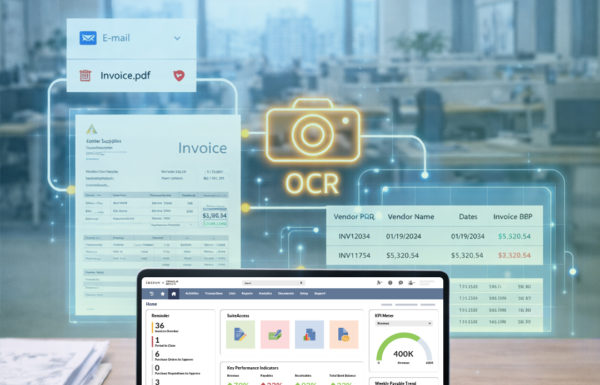
- NetSuite Bill Capture: Uses AI and OCR to scan vendor invoices, auto-populate expense lines, and execute three-way matching automatically.
- NetSuite Analytics Warehouse: Combines ERP data with CRM and e-commerce sources, using machine learning to uncover trends and build predictive dashboards in minutes.
- Intelligent Financial Close & Narrative Reporting: Speeds up multi-subsidiary consolidations and uses generative AI to draft financial commentary directly inside your reporting workflow.
AI in Accounting FAQs
Will AI replace accountants and auditors?
No. AI replaces repetitive, low-value tasks like manual data entry and basic reconciliations—not human judgment. Accountants who embrace AI tools become strategic advisors, focusing on tax strategy, risk management, and business growth.
How can small and mid-sized businesses start using AI in accounting?
SMBs do not need to hire in-house data scientists. The most cost-effective entry point is working with an experienced IT consultancy to deploy a cloud ERP system like Oracle NetSuite, which already includes embedded AI for invoice capture, bank reconciliation, and automated reporting.
Is AI safe for sensitive financial and audit data?
Yes, provided you use enterprise-grade cloud financial software. Reputable ERP providers enforce strict encryption, audit trails, and data isolation so your proprietary financial data is never exposed to public AI models.
Future-Proof Your Finance Team with Introv
Whether you are struggling with slow month-end closes, disconnected spreadsheets, or scaling across multiple entities, your trusted IT consultancy and Oracle NetSuite Partner, can help you design and deploy an AI-ready cloud accounting foundation tailored to your industry.
- Consultative IT & ERP Roadmap: Evaluate your current finance architecture and identify high-ROI automation opportunities.
- Proven NetSuite Implementation: Seamless deployment across Hong Kong and the wider APAC region.
- End-to-End Change Management & Support: Dedicated local consultants to help your finance team master AI-driven workflows.
Schedule Your Free Consultation & NetSuite AI Demo Today
By clicking "Submit", you have read and agreed to our Privacy Policy, including our Cookie Policy.